The Ink That Bled

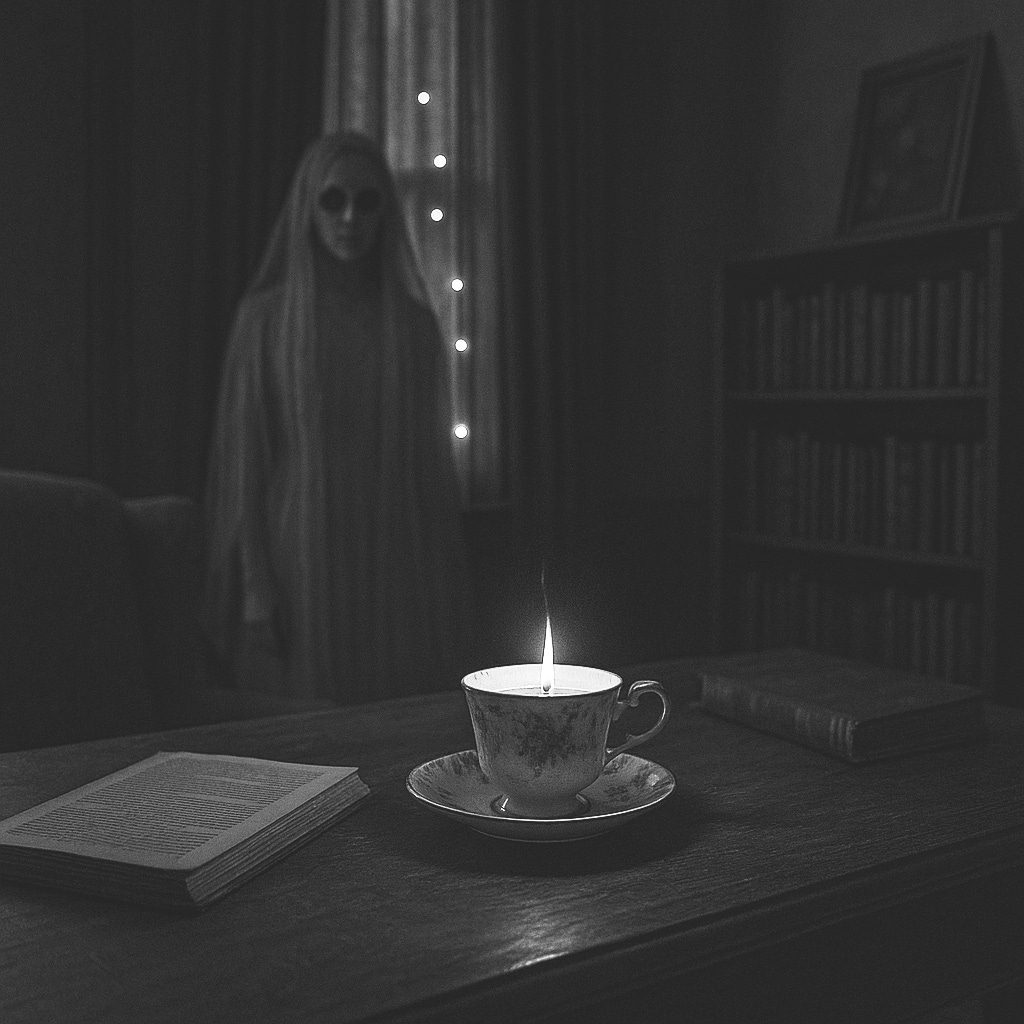
The shop was the kind that seemed to appear on rainy days and vanish under full sun. Narrow as a wound between a pawn shop and a boarded bodega, its bell jangled with an anaemic little tremor when Adrian Cole shouldered the door open. The sign above the lintel read OBOLUS & CO. in flaking gold, and beneath it a hand-painted skull with a coin set between its teeth smiled in a way Adrian did not like.
He had not meant to come here. His route from the subway to his apartment never took him down Mercer, but he had walked with his head down against a needle-rain and, at the corner where the florist used to be, turned right instead of left. He should have recognized the mistake within half a block. He didn’t. The rain needled harder. He told himself he was simply hiding from the weather when he ducked inside.
The place smelled like paper and cold iron.
Shelves leaned inward, loaded with oddments that made no useful sense: a metronome ticking without a pendulum, an hourglass full of black salt, a violin with one string, a child’s shoe wrapped tightly in twine. A glass case held trinkets that predated the city: brooches, coins, a pocket watch whose second hand had stalled between marks and could not decide where to live. Toward the back, beneath a muttering bank of low lamps, a shallow tray of fountain pens lay like daggers kept for small, careful murders.
“Can I help you?” a voice said, close and dry.
Adrian started. A man had assembled himself from behind the counter, thin as cord, his suit so dark it absorbed the lamp light. His eyes were the only lively part of him—watchful, quick. The nametag on his lapel read M. KARR.
“I’m just getting out of the rain,” Adrian said, already embarrassed. He felt the thrift-store coat on him like an accusation. A struggling writer in a shop for people who bought exactly the right lamp for their mantels and the right sadness for their bookshelves.
“Have a look,” Karr said, as if no one had ever said anything else to him. “There are things here that like to be looked at.”
Adrian moved toward the pens because he felt least ridiculous near objects designed to leave marks. He had written all morning and come away with nothing but an ache in the jaw where he clenched his teeth and a syndrome of emptiness behind his eyes. The deadline for his second novel had receded and receded until the idea of time felt like an insult. His editor’s last email had been measured but firm: Don’t disappear on me, Adrian. Get me something by Friday. Anything.
He lifted a pen from the tray because not lifting it would have drawn attention to his hovering hand. It was heavier than it looked, its barrel a black so black it was almost blue, a sheen like oil on water. The nib was dark too not gold, not steel. It looked like obsidian, sharpened into a tiny, perfect tongue. The cap was capped not with a clip but with a small coin inset flush with the end. A coin whose worn face showed a profile and the faint impression of letters he couldn’t immediately read.
“It’s handsome,” he said, because people say that about objects that unsettle them and they wish to pass on without being changed.
“It writes,” Karr said.
“So do they all.”
“They don’t,” Karr said, and it was not a correction so much as a kindness. “Most scratch. Most scratch because their owners ask them to write things the pens cannot bear. Try it.”
“I don’t” Adrian started. He meant to say he didn’t have the money or the heart for such affectations; he wrote in battered notebooks with a pencil he sharpened with a kitchen knife.
Karr slid a sheet of thick paper in front of him, and beside it a squat inkwell with a cracked label. The label was half-effaced by time but the remaining letters spelled SANGUIS in a florid script. When Karr unscrewed the inkwell cap the smell of it rose up and held Adrian still.
It smelled like copper pennies rubbed between teeth.
“Just a word,” Karr said. “Write whatever you mean.”
Adrian dipped the nib and the ink clung like it recognized an old mouth. He hadn’t written with a fountain pen since college. He expected blots, trembling lines. Instead the nib moved as if his hand had nothing to do with it. The first stroke felt like opening a vein. He wrote the word door because a door is a thing you can open and close and then pretend you had a choice about both.
The line he put on the paper was blacker than the ink in the well. It dried instantly, sunless. The letters looked like they were lying down and wouldn’t get up.
Karr watched with a precise neutrality that made Adrian feel observed in the way that makes men volunteer their secrets. “How much?” Adrian asked, softly, in the tone of a person who hopes the shopkeeper will laugh and say, For you? Nothing.
“For you?” Karr said, and his mouth twitched as if he had heard the thought exactly. “Fifty and your old pen.”
Adrian almost laughed. “I don’t have”
“Everyone has an old pen,” Karr said, and lifted a small tray from beneath the counter: wooden pencils chewed down to eraser nubs; a ballpoint whose brand had been worn away by anxious thumbs; a cheap roller with the cap gnawed; a felt-tip like a child’s marker; a fountain pen so dented it seemed to have been used as a hammer. People had traded in their habits here. People had traded in worse.
Adrian dug his own pen a clicker from a bank that had once declined him a loan from his coat. It felt like a betrayal to leave it. It felt good. He counted out fifty from the emergency cash in his pocket and pressed it down. Karr wrapped the pen in brown paper and twine, as if it had bones, and put it in his hand.
“A word of advice,” Karr said. “Don’t lie to it. It knows.”
“Knows what?”
“What the difference is,” Karr said, “between writing and pretending you are.”
By the time Adrian stepped back onto Mercer the rain had dwindled to a skin. When he turned to look at the shop, the sign above the door read OBOLUS & CO. as it had and the skull still grinned, but the windows reflected only the street and not himself at all.
He put the pen on his desk and left it there for a day, like a held breath.
His desk was a battlefield. A stack of notebooks written in loops and arrows and then crossed out into illegibility. A coffee cup that had fossilized into an archeological layer. Notes from Miriam, his editor, printed with sincerity: a tenderness under the horror—keep that; don’t explain the monster let it show; cut the cheap scares, trust the voice. He had trusted the voice once. Lately it sulked. Lately it let him sit and bleed into the keyboard while giving him nothing in return but the shape of his own despair.
He would write a sentence and delete it. He would write a page and put the page in a drawer and later fold it into a square and wedge it beneath a wobbly table leg. He had tried writing about the thing he could not stop seeing in the morning, that small unaccountable grief that woke with him and sat on the bed all day swinging its legs, and the sentences had turned neat and bad.
He unwrapped the pen after dark, when the city softened. It lay in his palm with the weight of a tool that had done work others were afraid to do. He uncapped it. He did not fill it. He pressed the nib to a blank page because he wanted to feel the scratch and the failure and to say: see, even this won’t save me.
The pen drew a line that widened and then narrowed to a hair, elegant as a surgeon’s cut. The nib was wet without ink. He lifted it and looked. The slit in the nib gleamed wet and clean. His name rose in his throat; he swallowed it. He pressed the pen down again and wrote what he swore he would not write: I watched her die in the reflection first.
He had not meant to write about the alley. He did not know which her he meant until the second sentence arrived under his hand. He had been blocking a scene for a month: a woman cut through the alley behind the bodega because the main lights had gone out and the alley was the shorter way and because people always think nothing happens to them. He had written She heard and She turned and She told herself and all of it had been scaffolding around an empty box. Now the box had something in it. He wrote fast, not because he wanted to but because if he did not the sentences dragged their nails on the inside of his skull. The woman paused at the steel door of the deli, caught her face in it flattened by dented metal, smeared by old grease—and saw behind her something tall and patient. The reflection was a fraction ahead of her. The reflection showed her death before she turned to meet it. The scene unspooled, sure and cold. The thing behind her did not rush. The reflection’s eyes went wider a second before her real eyes did. When the blade went in the reflection’s throat, a line opened in the steel, a scratch too deep to be a scratch.
He wrote until his hand cramped, until the pen warmed his fingers like a fever. When he stopped he realized both windows were open and his breath had condensed on the glass despite the steam.
He slept badly and dreamed the coin in the pen’s cap turned and turned under skin, like a fish trying to find a hole in a net.
He sent the scene to Miriam in the morning against his own superstition. She wrote back six minutes later: There you are. And then, after a beat, a second email: This is the line you’ve been circling more like this. Don’t over-explain the reflection. Let it be awful. Keep going.
He kept going.
The words came in a skin-prickle urgency he both dreaded and adored. He did not need to fill the pen. It never ran out. He noticed, after the first week, that the inkwell with the SANGUIS label was lower even though he had not dipped the nib again. He noticed a faint brown stain blooming at the base of his thumbnail on the hand he wrote with that did not scrub off.
He posted a small excerpt to his author site because he needed to prove to himself that the shape on the page was not an hallucination. Fans responded in the tuned way fans have: chills; you’re back; this has teeth; careful with that reflection, I live by an alley lol. One user with the handle kromekat wrote: I walk past that exact deli. Creepy. Another: do the kill scene no balls. A third, Petal&Bone: When? When??
He told himself to log out. He went back to the desk.
On Wednesday morning the news ran a two-minute segment on a local homicide in a narrow alley behind a bodega on Delancey. The victim had not been named. The anchor said police are asking anyone who might have seen something and residents tell us this is a quiet block, people are shocked and other things anchors must say. The footage showed the deli door, dented, slick. A deep fresh line marred the steel where no gouge had been yesterday.
Adrian stood in front of the television with the remote aimed at nothing. The scene he had written a day ago ran under him like a river and dragged him toward a waterfall.
He turned the television off and listened to the silence press his ears. The pen lay on the desk uncapped. He put the cap on with shaking care and placed it in the drawer and closed the drawer and put the chair under the desk and, because he was not a child, did not stack a chair on top of the desk as well.
At noon, Miriam called.
“Did you see the news?” she said, and then, without waiting, “No, of course you did, you’re a sponge for the worst thing. It’s uncanny.”
“It’s not” he started. He meant to say It’s not uncanny or It’s coincidence or This is not that. He said, “I need a day.”
“You need a page,” she said, but her voice softened. “Take your day. Then send me chapter five before you convince yourself it’s not good enough to exist.”
He agreed like a coward. He did not write. He sat in a chair and counted to a thousand and then counted again and the numbers did not contain him. The drawer was warm when he opened it. The pen lay straight and patient in the felt. He left it there until dusk and then took it out because the sentence in his throat had cut him and would not stop bleeding: He told himself he would not look at the window because the window looked back.
He wrote the second killing without meaning to write a second killing. This one happened on a train. A man with a kindly face had made a habit of standing close to sleeping women. He did not touch them did not at first but he told himself a story about how he was a harmless man with invisible needs and the story had let him live inside it without ever seeing himself. In Adrian’s scene the man chose the wrong woman. She opened her eyes in the reflection of the window before she opened them in her face. He saw his own smile go waxy and wrong on the glass a second before his actual smile did. He watched in the reflection as hands his? not his? closed around his throat and lifted him slightly off his feet. No one on the car looked up from their phones. The straps above him swung. His face in the reflected window twisted a half-second before the real one, and when the train pulled into Broadway-Lafayette he was somehow not standing anymore.
Adrian could feel the curve of the woman’s fingernails in his own skin as he wrote. He could smell the medal-penny hum of the pen and the underground grease of the car and, under that, something like heat in a mouth that isn’t alive.
He didn’t post that excerpt. He emailed it to Miriam and then shut the laptop and walked around the block three times. He kept seeing himself in windows and the selves in the windows were not perfectly him.
The next morning the news ran a story about a man in cardiac arrest on the F train who had not made it to the hospital. They did not mention strangulation. They did not mention the police. They did not show the window.
He did not write for two days.
The dreams found him anyway. Letters crawled under the skin of his arms, pale and raised like old scars. He dreamed he bit the coin set into the pen and it tasted like something he remembered from childhood, like chewing a foil-wrapped chocolate and catching metal on a filling. He woke with the taste in his mouth, metallic and sweet and wrong. When he brushed his teeth the foam came away pink as if a small animal had died in his gums.
On Friday his ex, Lila, texted him: You alive? Your site is wild. I miss your brain. Please eat something. He almost wrote I have a haunted pen and did not. He almost wrote Remember when we used to fall asleep listening to that podcast about cursed artifacts and laugh? and did not. He wrote I’m okay. Meeting deadline. We should talk when I’m human again. She sent a thumbs-up and a heart and a photo of a cat that was not theirs.
He stared at the pen in the drawer and thought about rules. He had grown up on rules—if you don’t say a thing, it might not be true; if you don’t look at it, it might go away; if you hold your breath you can pass the place where the dead live without them seeing you. He believed in ritual. He did not believe in magic. He set the pen on the desk and asked, aloud, feeling ridiculous, “What do you want.”
The room held its breath. Somewhere beyond the wall someone laughed and then coughed and then stopped. A drop of something the size of a tear formed at the nib and bulged, heavy, and then broke, leaving a dot so black on the paper it looked like a missing piece of the page.
He wrote a rule: What I write cannot become true if I do not permit it.
He wrote: I do not permit it.
The pen made a line across both sentences like a schoolmaster’s cane. He could not say afterward whether the line came from the nib or from something else. He put his thumb to the line and lifted it away. His thumbprint lingered in negative, bloodless.
He stopped showing anyone the pages. He wrote in a notebook with the blinds down and the lights off because the lamp made the shadows around the desk too complicated. He wrote scenes that were only rooms full of the quiet you get when people have just left and the air hasn’t settled back into itself yet. He wrote men bending toward women in public places and the women going very still and the men not noticing the stillness was a decision. He wrote a woman in a blue coat stopping to read a taped flyer on a telephone pole and the pole’s shadow shifting toward her and her shadow staying where it was. He wrote a boy at a window drawing on the condensation with his finger as his mother slept on the couch, and in the picture he drew was a door that wasn’t the front door, and when he drew the handle on that door it reflected more light than a drawing should.
He did not type any of it. He kept the notebook in the freezer when he wasn’t writing because the idea made him laugh at himself. The freezer hummed low and faithful and did not complain about keeping under glass the small animal that was his book.
On a Tuesday, he found his notebook sitting on his keyboard, dry. In his own hand, a line he did not remember writing ended at the bottom of the page and then continued in a script not his into the next: Miriam says readers like a body by page forty.
He sat very still and listened for his own breath and did not hear it for a length of time that made the back of his neck go tight. He texted Miriam: Did I send you anything?
She wrote: You didn’t but I had a dream you did and I woke up and checked email. Nothing. You okay? You’re on a roll. Ride it, Ade.
He wrote back: Do not read any excerpts online. Then, realizing he sounded mad: I’m trying something. It’s fragile. Trust me.
She wrote: Always have.
He went outside and walked to the corner where the old florist had been and found a nail salon. He walked two more blocks to Mercer and found a boarded facade. He doubled back to where OBOLUS & CO. should be and found a mural of a river painted in blues so deep they looked like bruises. No skull. No bell. He stood until he started to suspect that he had made the shop up the way scared children make up monsters to explain the ordinary harm of the world. He tasted blood in the back of his mouth and could not tell where it came from.
That night the pen would not let him sleep. It sat on the desk and made a sound like a hair being pulled straight, a high, particulate sound he felt more than heard. He put it in the freezer with the notebook. He took it out again five minutes later because leaving it there felt like leaving a dog in a car. He put it in the sink and turned the tap on and watched the water run black and run clear and run black again. He turned off the water and held the pen in a towel and the towel took no stain. He went to the window to throw the pen into the alley and saw himself reflected one second ahead of himself. His reflection lifted its hand a moment before he did.
The next morning four messages waited on his site, each a short, nervous thing: is this a joke.; tell me you didn’t; pls answer; and from Petal&Bone: my cousin never came home last night.
Adrian closed the laptop so quickly it made a noise like a mouth breaking a kiss.
He wrote.
The woman in the blue coat found her reflection lagging half a second behind. The pages bled sentences that drew their own shadows. He wrote with both hands in a panic and did not remember when he had taught his left to do this. The pen bit the paper over and over and the desk under it wore a groove and the groove widened and deepened and smelled like pennies. He wrote endings for everyone but none for himself and at three in the morning the apartment’s heat clicked off and did not click back on and his breath showed in front of his face.
He slept on the couch with the pen in his hand because the idea of setting it down made the hair under his arms get ready to stand up. He dreamed he was twelve and his father had sat at the kitchen table sharpening a buck knife with long draws down a stone and had said, “If you cut the thing right the thing doesn’t bleed.” He woke to the taste of metal and a line on his forearm the width of a hair that seeped a little and wrote a word he could not read until it raised into a welt.
Lila called in the morning. “I dreamed you swallowed a fishhook,” she said without hello. “We’re not talking but I couldn’t not tell you that. It felt like a warning.”
He started to make a sound like laughter and made a sound like something falling down a stair. “I’m sorry for everything before,” he said, which was not about a fishhook.
“Is there someone with you, Adrian?” she said.
“Yes,” he said. “No.”
“Come over,” she said. “Don’t be alone when you sound like that. I have soup. And locks. And I can make your brain stop grinding its gears for an hour.”
He almost went. He wanted to hand the pen to someone else and say hold this while I breathe and then keep walking until the city ended and a field began and no one spoke his name there. He told her he would come and then stared at the door for a long time and did not move.
He wrote the scene where the boy at the window drew a door that wasn’t and then was. He wrote the door opening. He wrote his own name on the other side, not because he meant to include himself but because the pen bent his hand a degree and the word took.
After he wrote his name the lights in the hallway outside his apartment popped—one, then two, then the third and the hall ran dark. Someone in 3B swore softly. A child in 3A said daddy? in a voice that split something in Adrian like an old seam.
He stood. He put on shoes. He put the pen in his pocket because leaving it didn’t feel possible. He opened his door and stepped out and the hallway’s blackness pressed against his face like a blindfold. He stood until his eyes invented shapes and then found the stair railing with his hand and went down.
On the second-floor landing he smelled it: tobacco. Not the cheap acrid smoke people get from lying about quitting. The warm sweet pipe odor of a habit kept in a chair near a window. He followed the smell through the second-floor hall and to the end where a window that had never opened was open, a crack, and the cold came. On the sill lay a coin the size of a thumbnail, old enough that the letters around the profile had worn to scratches. The coin was inset into a cap of black lacquer. The cap had no pen attached.
He touched the coin. His tongue filled with iron. His eyes filled with letters. The window swung inward as if someone’s hand had been on it and had tired of pretending otherwise.
“Do you want,” a voice behind him said, “to stop.”
He turned. The hallway was empty. The voice was not Lila’s or Miriam’s or his father’s or any of the dead he knew. It was the voice you hear when a page turns in a silent room.
“Yes,” he whispered because he did.
“Then write it,” the voice said. “End it.”
He went back upstairs carrying the cap with the coin set in it as if it were the crown of a tooth the mouth had rejected. He sat at the desk. He set the cap on the pen and felt something in his chest slide into place with a relief that made him want to keep it and a terror that made him know he could not.
He opened the notebook. He did not think. He wrote: This is how it ends.
He wrote: It ends with a body.
He wrote: It ends with a man who would do anything to keep other people safe from what his words do.
He wrote: He understands what the pen wants from him.
He wrote: It wants blood. It has always been blood. The ink was never ink.
He wrote: He understands the arithmetic: one for many.
He wrote his name again because the page would not take any other. He wrote Adrian until the letters blurred and the pen cut through and scored the desk under, deep.
The nib caught and would not lift. He pulled. It did not let go. It was in the page and in the wood and then it was in his hand.
The cold came up his arm in a line like winter. He looked down and saw a thin black thread moving under his skin from the web of his thumb toward his wrist, slow and exact. The pen drank. He tried to pull it away and the pen pulled back. He thought absurdly of a dog with a rope toy that will not surrender because surrender is not the game.
“Okay,” he said, aloud to something that was not in the room and was everywhere. “Okay.”
He put the pen to the page again and wrote the last paragraph with a hand that felt like a glove filled with ice. He wrote his death with a care that made him ashamed and proud. He wrote He leans forward and He opens his throat and He bleeds where the letters have been waiting and the nib slipped under his jaw for a second so small it would not have held anything if it had not been invented to hold exactly this. He wrote He bleeds into the pen and the pen filled and filled and filled and the notebook paper buckled and the desk darkened and the coil of black under his skin unspooled into something like calm.
The last sentence took him a long time to aim. He wanted it to be a door. He wanted it to be a warning. He wanted it to be a kindness to someone who would come across it. He made it a fact.
The story ends because the writer ends it.
He put the period on the sentence with the stubborn love of a man who has done something wrong all his life and has at last done one right thing.
He did not fall. He did not thrash. He had imagined death a mess. It was quiet. He was tired. He felt, dimly, the chair under him and the coolness of the floor through the soles of his shoes and the way the room smelled like pennies and old pages and rain that would come. He thought of Lila standing in her kitchen holding a spoon and looking at her phone and making the choice not to call again right then because she did not want to be the woman who begged. He thought of Miriam opening an email tomorrow and finding no attachment and letting herself be angry because anger is easier than fear. He thought of the boy at the window. He watched the door that wasn’t open and then was open. He saw his name beyond it as if someone else had written it on purpose.
He thought: I am sorry.
He thought: Thank you.
He thought: Don’t pick it up.
He did not think anymore.
It was three days before the super entered to check the heat. He noticed the thin dark line under Adrian’s door before anything else. A spill? A leak? He knocked and waited and knocked again and said Maintenance and Hey, with a voice that sounded like his father’s on days when his father knocked on doors he did not want to open.
The police came and did what police do in rooms that keep secrets. They wrote down the obvious and missed the other. The coroner wrote exsanguination and self-inflicted and made his notes without stating aloud the question that hovered near his mouth. On the desk they found a notebook open to a sentence that had soaked through to six pages and an old pen whose barrel had no seam and no maker’s mark. One of the uniforms lifted the pen in a gloved hand and sniffed and grimaced and said ink like a joke he did not want to make.
The detective in the warm coat thumbed his phone, frowning at the author site a rookie had pulled up. This guy writes this stuff for a living, he said, not to anyone. He scrolled past the excerpt with the alley and shook his head and did not connect the stainless-steel door on Delancey with the room he was in because he would not be the sort of man who sees patterns in grief; he would be the other sort, the safe sort, who sees grief and goes home and kisses his wife and listens for the sound grief makes in other men.
They bagged the pen. In the evidence room later, under light that flattened everything, the bag’s plastic fogged a little where the pen lay. The tech logged it and put it on a shelf beside knives that had done ordinary domestic tragedies and a length of chain from a basement and a phone with a cracked face that lit up at odd hours. On the pen’s cap the inset coin gleamed dull. Letters around the worn profile caught the light just enough to be letters again, not scratches. OBOLVS, it read, and beneath that the suggestion of a second word that would not hold still.
Miriam came the next day because her anger had softened into fear and then into a certainty she could not explain. She sat in the hall once the tape came down and put her hands between her knees and whispered his name. She spoke to a detective who did not say the word suicide until he had to. She called Lila. They sat on the stairs with paper cups of coffee and told each other stories where he was late and would arrive and where this was not the last page.
Petal&Bone posted a comment: I told you this was not funny. Someone else wrote: RIP. Someone else wrote: He manifested it. Someone wrote: His last line slaps. Someone wrote: You people are sick. The comments stacked until the site’s host throttled the thread.
In storage, the pen lay very still.
On Friday, a young evidence clerk with a tear in her sleeve reached for the next case number and her fingers touched the pen bag. The bag was warm. She turned it in her hand, squinting. She did not read Latin. She knew, because she read cheaply printed books on her lunch break when she should have been reading the manual, that some stories got into your hands and left marks.
She set the pen down.
Then, because she was the sort of person stories look back at, she picked it up again.
She thought she heard a sound like a page turning. She thought she smelled rain where there was no window. She felt a little dizzy. She reached for the log to sign the pen into a different bin. The pen rolled a fraction toward her, as if it had found the low part of the shelf. The bag made a sound against the laminate like a breath.
She blinked and put the pen back, harder than necessary, as if to convince herself of gravity.
Outside, a storm walked over the city but did not break. Windows reflected rooms. Rooms reflected faces. In one window, for a second, a reflection lifted a hand before the person in the room did.
On Adrian’s desk, the notebook lay open to the last line. The period had dried into a small black well. A gnat landed at the edge and drank and flew unevenly toward the window.
Somewhere, a bell over a door jingled once, as if a shop no one could find had opened for the day.
If there is a mercy in endings, it is not for the one who wrote them. It is for the ones who keep reading and decide to stop.
You should stop now.
Don’t pick it up.